Architecture
This page explains what the parts are and why they are separate. The guide builds a deployment step by step. The API reference gives exact signatures.
The shape
A shared agent is one deployable application, assembled from parts:
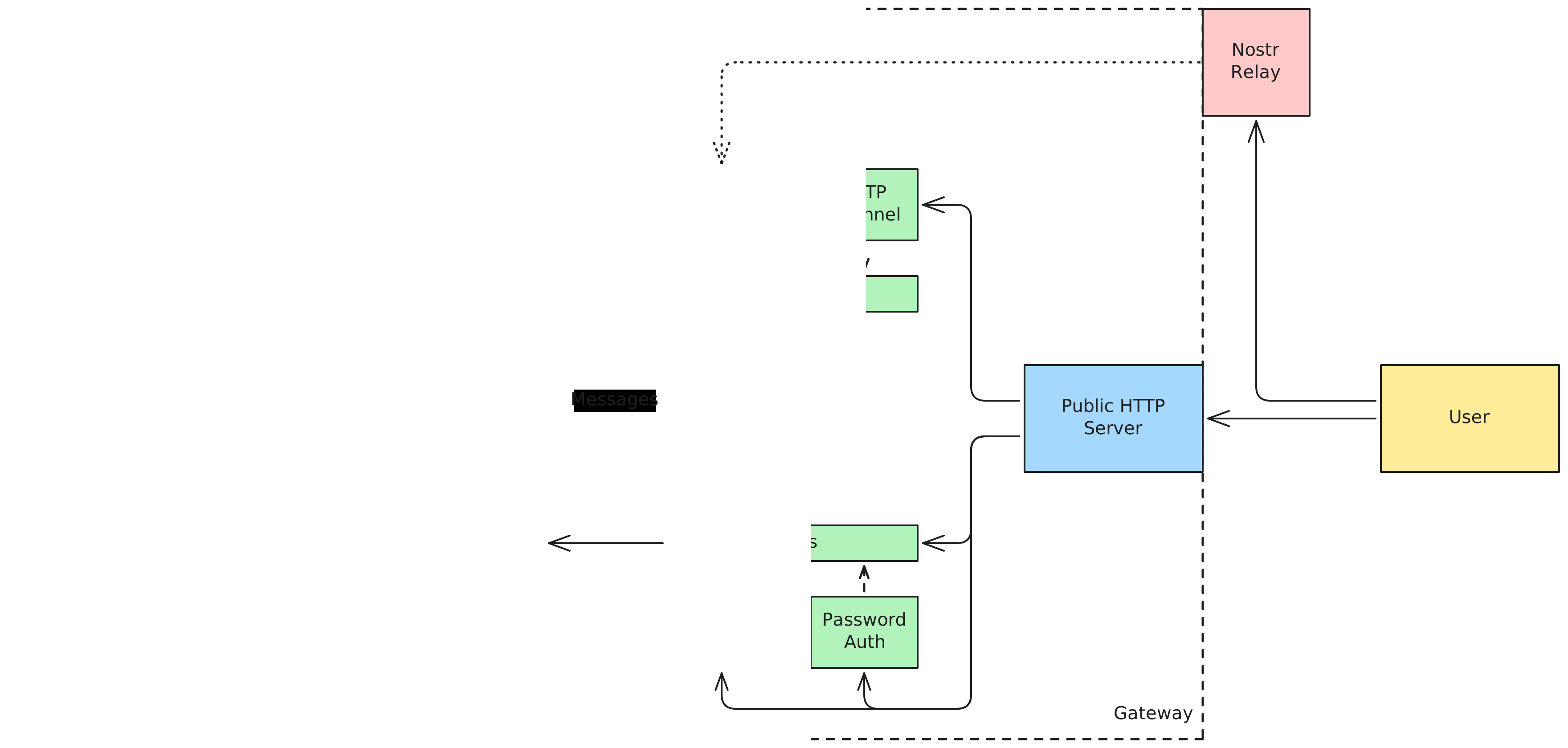
The dashed boundary is the Gateway, and it is the only path between a person and the agent. What is drawn inside it in blue is the infrastructure createGateway builds for every deployment. What is drawn in green is components, which a deployment builds by hand and picks for itself: these four are the messaging and identity half, and Signatures, Decisions and the Scheduler are not drawn, so read the green boxes as examples of a component rather than as the whole set. What is drawn outside is what the Gateway does not own: the Agent Implementation in its container, the person's own client, and a Relay.
The wiring the picture is most exact about is Users and the Messenger, and it is worth reading twice. Each Channel hands what it received to the one Messenger, and each Auth answers with a User from the one Users. Neither pair is a chain of two Messengers or two Users. That is the shape an Auth and a Channel exist to make.
This is the path that one message takes through the same parts:
   a person                                time
      |                                     |
      v                                     |
   Channel          one medium              |
      |                                     |
      v                                     v
   Messenger  --> Message log            Scheduler
      |                                     |
      |  emits a Signal                     |  emits a Signal
      +------------------+------------------+
                         |
                         v
                  Signal Worker            one Run at a time, globally
                         |
                         v
                  Signal Handler           your code
                         |
                         |  zero or more Prompts
                         v
                      Runtime
                         |
                         v
              Agent Implementation         in a container
                         |
                         |  calls back over HTTP
                         v
                   Agent server            no authentication
Those parts sit in three rings, from the inside out:
- The Agent Implementation runs the model. It is
piby default, driven by a Runtime, and it runs in a container. - The Signal Worker owns the Signal queue, the dispatch to Handlers, and the Runs. It holds no identity and knows nothing about messaging.
- Producers are trusted parts that emit Signals into the Worker. The Messenger and the Scheduler are the two that ship.
Only the Gateway connects a person to the agent. There is no other path.
The loop
One message produces one pass through this loop:
- A person sends a Message to a Channel.
- The Channel hands it to the Messenger, which stores it and emits a Signal. Both happen in one transaction.
- The Signal Worker takes the oldest pending Signal.
- It dispatches on the Signal's
kindto exactly one Signal Handler. - The Handler returns zero or more Prompts, each naming a Session.
- For each Prompt the Runtime starts a Run.
- During the Run the agent calls the Agent server. It reads Messages, sends Messages, and reads Users.
- An outbound Message is written to the log and handed to the Channel.
- The Handler's optional post phase runs, and is told whether any Run failed.
The person reads the answer by polling their own Message log, or receives it in their own client, depending on the Channel.
The Gateway
A Gateway is a record of Components, keyed by names you choose. It starts them in key order and stops them in the reverse of that order. A failed start unwinds what already started.
A Component is a start and a stop, and nothing else. It has no name, declares no dependency, and resolves nothing. The parts already hold each other, because you passed them to each other.
This is not a plugin system and not a registry. A part handed a server registers its routes in its own constructor.
createGateway
createGateway builds the irreducible infrastructure that every deployment needs:
| Key | What it is |
|---|---|
db | The PostgreSQL client. It owns the pool and the LISTEN connections. |
agentServer | The server the Agent Implementation reaches. |
publicServer | The server people reach. |
worker | The serial Signal Worker. |
Your extend function receives those four and returns components of your own. Your handlers function runs after extend, so a Handler can reach a component you built. The reverse is not possible.
The four infrastructure keys are a type error in what extend returns. Otherwise a spread overwrites one in silence.
createBareGateway takes a record of Components and is the escape one layer down. A deployment whose infrastructure shape itself differs uses it.
Start order
The Signal Worker is keyed last, so it stops first. Its stop is the only one that waits on work in flight: it waits for the Run. That drain therefore runs while every server still listens and the pool is still open.
Other stops release resources rather than wait. The Db closes its pool and its LISTEN connections, each server closes itself, and the Nostr Channel closes its Relay connection.
Your own components are keyed ahead of the Worker. They start before it and stop after the drain. That is correct for anything the drain uses, such as the Messenger a post phase calls.
The two servers
The difference between the two servers is the trust boundary.
| Public server | Agent server | |
|---|---|---|
| Who reaches it | People | The Agent Implementation |
| Authentication | Every registered Auth | None |
| Sees Signals | No | Yes |
| Reads any person's Message log | No | Yes |
| Can sign a Statement | No | Yes |
| Can create a User | No | No |
| Can set another person's password | No | No |
Neither server creates a User, and neither sets a password for somebody else. Both are methods that only your own code can call.
Reaching the Agent server port is access to every route on it. Keeping that port unreachable is the deployment's responsibility.
A person reaches Users, their Auth's own routes, a Channel, Decisions, and two of the three Signature routes. Over HTTP with Password Auth, those Auth routes are a login, a logout, and a change of their own password. People never see a Signal, and they never reach POST /sign.
Both servers describe themselves. Each registers OpenAPI generation before extend runs, because route discovery is a hook that fires as each component registers. The document at /openapi.json is therefore the truth about what a Gateway serves.
The Runtime and the Agent Implementation
The Runtime is the narrowest interface in the framework:
type Runtime = {
  run(prompt: RunPrompt): Promise<RunOutcome>;
};
One method, one argument, one outcome. A second Agent Implementation is one function.
The Runtime is held by the Signal Worker and is never started. It is not a Component.
It is called one Run at a time, never concurrently. No implementation needs locking.
createPiRuntime runs pi in a container. The Prompt goes on standard input, never in the argument list. Nothing about the model, the provider, or the session directory comes from the framework: those come from a mounted settings file and from the image.
The Agent Container
The container plumbing is separate from pi, on its own subpath, because a second Agent Implementation needs it unchanged. It is what docker run takes, and what to do with the result.
A Mount Table declares what the container reaches on disk. It has one required runtimeDir, which is a path on the host, and every entry is written relative to it. The table verifies nothing about the filesystem, and it refuses four things that cannot mean what they say:
- An
agentPaththat is not absolute. - A leading slash on an entry's
path. - A
.or..segment in a resolved path. - Two entries that resolve to one target.
Every Run is --rm and --interactive, which holds stdin open and gives the container no TTY. It runs as the Gateway process's own user and group, where the platform reports them. Env values are redacted in the loggable copy of the command.
Signals, Runs, and Handlers
A Signal is an arrival record, emitted by a trusted Producer. It carries a kind, an arbitrary JSON payload, and a timestamp. There is no user id column: the Signal Worker authenticates nobody, so attribution is not a fact it holds. The Messenger's payload carries the User id, which is trustworthy because that component wrote it.
A Run is one Prompt executed in one Session. Its session is a plain name, not a foreign key. Sessions live inside the Agent Implementation.
A Signal Handler is arbitrary code and is the primary extension point:
type SignalHandler<TPayload = unknown> = {
  handle(signal: Signal<TPayload>): readonly Prompt[] | Promise<readonly Prompt[]>;
  post?(signal: Signal<TPayload>, outcome: PostOutcome): void | Promise<void>;
};
handle receives the Signal and nothing else. There is no context object and no second argument.
Returning zero Prompts means the Signal is done and no Run happens. The arrival record stays, so a refusal is auditable. Returning many Prompts fans out, and one failure does not stop the rest.
The post phase runs once, after every Run from that Signal has finished. It cannot produce Prompts. It is the whole of the framework's failure handling, and it is how "that failed" reaches the person who asked.
templateHandler is the common case. It renders a Handlebars template into one Prompt. The template is source text, never a path, and it compiles when the Gateway is built. A template that does not compile therefore fails construction rather than a Signal.
At-most-once
A Signal that fails is never retried. A Signal left in processing by a stopped Worker is failed at the next start. Nothing cancels, retries, reprioritizes, or removes a Signal.
This is why the post phase exists, and why a template compiles early.
Core components
Every part a deployment assembles is a Component. A deployment builds only the ones it wants, and each one below is a single create* call inside extend.
Users
Users owns who exists, and their attributes. It owns no credential.
Creating a User and setting attributes are methods, never routes. An agent that can create a User and give it a credential has made itself an account.
Nothing removes a User. Revoking their Tokens is the whole of it.
Users is not a Producer. A Signal for each login puts a Run behind every authentication, and the Worker is serial.
Auth
An Auth owns one scheme's secret, and turns a request carrying it into a User. The diagram above draws two of them below one Users, which is the same shape the Channels make above the Messenger:
type Auth = Component & {
  readonly scheme: string;
  authenticate(request: FastifyRequest): Promise<AuthOutcome>;
};
An Auth answers with a User record rather than an id, because the server that walks the Auths can resolve nothing itself.
The Public server aggregates them. It reads the registered Auths on each request, in registration order. The first authenticated outcome assigns the User and continues. The first refused outcome ends the request. Every 401 carries one challenge per registered Auth, so two Auths that carry one scheme name it twice.
Two Auths ship:
- Password Auth owns scrypt hashes and Tokens. A password is traded for a bearer Token. The login derives against a fixed dummy digest when the User is unknown, so a miss costs what a hit costs.
- Nostr Auth verifies a NIP-98 event on every request and issues nothing. It records each admitted event, so a credential is spent once. Its freshness window applies in both directions, so an event stamped in the future is refused rather than valid forever.
Both own tables. An Auth is the component most likely to be assumed stateless, and what an Auth owns is a secret. A secret is a row.
The Messenger and Channels
Messaging is two parts, and the diagram above draws both: two Channels above one Messenger, each handing what it received down to it.
The Messenger owns the Message log and reaches nobody. One table, one text per Message, and one sequence per User across both directions. One cursored read therefore serves both polling and rendering.
A Channel is what reaches a person over one medium:
type Channel = Component & {
  readonly name: string;
  send<TSchema extends Record<string, unknown>>(
    tx: Handle<TSchema>,
    message: MessageRecord,
  ): Promise<void>;
};
send receives an outbound Message inside the transaction that is writing it. The promise is only that the Message is the Channel's now. Arrival is not something every medium can promise.
A Channel must not perform the network act inside send. A publish cannot be rolled back and a transaction can. An implementation does everything knowable synchronously, throws for anything wrong, and lets whatever must travel travel after the commit.
There is no public receive. Registration hands back a private handle, so no other code can put words in a person's log.
One Channel per Messenger is refused at registration. A deployment runs one medium.
Two Channels ship:
- The HTTP Channel has no tables and no work at either end. Its
sendis a no-op, because HTTP delivery is the person asking. It serves a submission route and a cursored poll. - The Nostr Channel exchanges NIP-17 private direct messages over one Relay. It owns three tables: which key is which User, which envelopes it has read, and which replies the Relay has not taken. It registers no route on either server.
The Nostr Channel is the counter-example that says a Channel is not a tableless kind of thing.
Signatures and Decisions
Signatures holds the agent's signing identity and stores nothing at all. What it makes is a Signed Statement: a compact JWS, verifiable by ordinary JOSE tooling in any language.
The deployment loads the key. The framework parses no PEM and generates no keypair. A deployment brings its own identity or does not start.
Decisions is the log of commitments worth keeping. It is global, addressed to nobody, and read by any authenticated person. It is the framework's only shared read: everyone sees the same rows.
What a signature proves is narrow. It proves that the Operator committed to this Statement on the agent's behalf. It proves nothing whatever about the agent's conduct.
Its audience is a party who never touches the Gateway and holds only a public key.
The Scheduler
The Scheduler emits one fixed kind when a Schedule matures. It is a timer in front of the ordinary dispatch, and it adds no Handler concept.
It supports recurrence, one-shots, cancellation, and time zones. A missed fire is never replayed: every next fire is derived strictly forward from now.
Its agent-facing routes are optional. An agent that can wake itself can fill the one serial Signal lane and never empty it.
Two identities, held apart
A shared agent has two identities and no more.
| Signing identity | Nostr identity | |
|---|---|---|
| Key | Ed25519, or P-256, P-384, P-521 | secp256k1 |
| Lives on | Signatures | The Nostr Channel |
| Answers to | A third party who never touches the Gateway | The people talking to the agent |
| Copying it | Forges the agent's commitments | Impersonates the agent to them |
Neither can be the other. Nostr requires secp256k1, and Signatures refuses that curve. Nothing in the framework answers "who is this agent" across both, and nothing tries.
Data ownership
Each part owns one PostgreSQL schema, named for its subject rather than for the part. No table references another part's, with six exceptions that all point one way.
Those six are foreign keys onto concorde_users.users.id. The Messenger declares one, the Nostr Channel declares two, Password Auth declares two, and Nostr Auth declares one. The Users component references nobody back.
Half of them belong to an Auth. That is what "the seam is who owns the secret" costs in the schema.
The framework applies no DDL. It ships schema definitions on a /schema subpath below each component, and the Operator applies them with their own drizzle-kit. There is no migration tracking table and no registration order.
Two components own no tables: Signatures, because a Signed Statement is never kept, and the HTTP Channel, because the log is the Messenger's and HTTP delivery needs no queue.
What you must provide yourself
Each of these is a deliberate decision, not an omission. Read the whole list before you deploy.
- Confidentiality between parties. The agent reads everything and decides what to send to whom.
- Resistance to prompt injection. This risk is accepted. Guidance to Handler authors is the only mitigation.
- Confinement of the Agent Implementation. The deployment confines it.
- An unreachable Agent server. There is no authentication on it. The bind address your entry point states is the whole of the protection.
- Rate limiting. The login route is unthrottled and no lockout exists. Rate limiting belongs at your edge, where it survives a second Gateway process.
- Account recovery. There is no email, no reset flow, and no security questions. A forgotten password is trusted code setting a new one.
- Removal of a person. Nothing removes or deactivates a User.
- Key rotation, for either identity. No record carries a key identifier.
- Non-repudiation of the conversation. No party can prove what the agent was told or replied. Signed Statements are not an exception to this.
- Isolation of any kind. A deployment that needs real isolation runs two shared agents.
Known limits
- One Run at a time, globally. Throughput is roughly one Run per Run duration for the whole agent. A short question queues behind a long task.
- Nothing is bounded by time. There is no Run timeout and no Handler timeout. A wedged call halts every party until the Operator restarts the process.
- At-most-once processing. A failed Signal is dropped after partial effect.
- A withheld Decision is undetectable. A gap in the sequence means a rolled-back transaction, and the Operator owns the database.
- Swapping the Agent Implementation means rewriting the agent's configuration.
Where the rationale lives
Every decision above was recorded when it was made, with the alternatives that were refused and what each choice costs. Those records live in the repository, as numbered decision records under docs/adr/.
This page states what is true. Those records state why.